
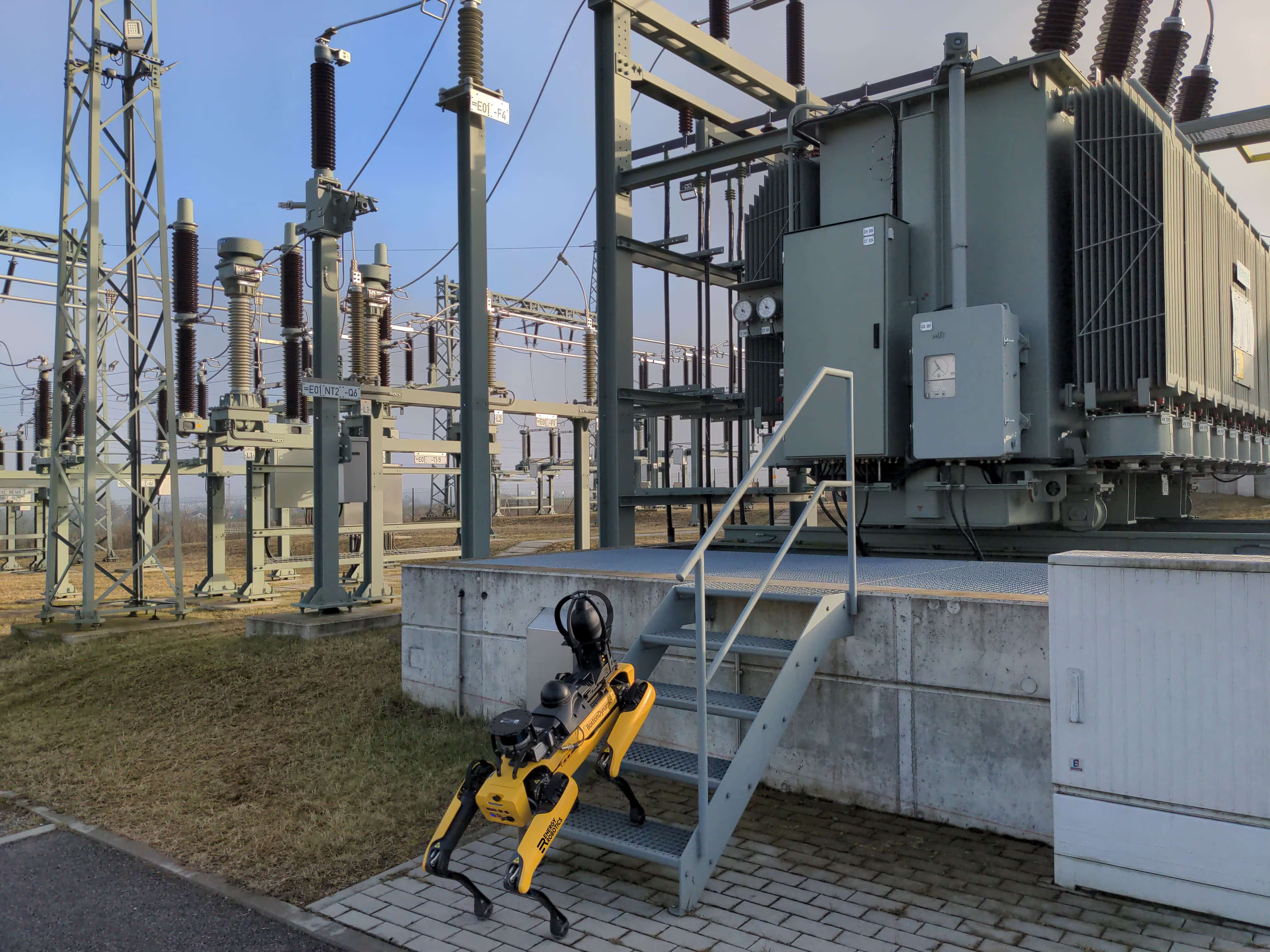
One Grid, One Robot Platform
Executive
Summary
Substations are the unsung hardware of the grid - the “sockets” that step voltage up or down and keep the lights on across millions of homes and factories.
They are also among the most inspection‑intensive assets any grid operator owns: dozens of switchgear cabinets, transformers, cooling units, and indicator displays that somebody has to check, log, and photograph on a regular cycle.
For E.ON’s grid, that somebody was increasingly hard to find, and the drive time alone was eating hours that engineers could not get back. Three subsidiaries - E.DIS, Bayernwerk, and Avacon - independently arrived at the same answer: autonomous mobile robots running on one platform from Korial.
The Challenge
Substations under pressure
E.ON’s substations are dense, safety‑critical environments where inspection teams depend on regular rounds to read gauges and indicators, listen for abnormal sounds, and capture photographic evidence.
Critical anomalies in temperature, partial discharge, or equipment condition could only be identified once readings visibly drifted or issues became audible, creating potential for unplanned downtime and costly consequences. As the asset base aged - with many substations built between the 1950s and 1970s - inspection requirements intensified just as experienced technicians became harder to staff and retain.
Each subsidiary started piloting individual robots, but each OEM understandably brought its own interface and data model, resulting in a diverse fleet that was harder to manage as deployments grew. Instead of a single source of truth, grid operators faced scattered sensor streams and a continued reliance on manual data interpretation, which made it difficult to govern inspection quality consistently across regions.
The Solution
A Shared Robot Platform
E.DIS, Bayernwerk, and Avacon converged on the same operational model: one grid, one robot platform.
Three subsidiaries that had arrived at the same answer independently now share a common way to run autonomous mobile robots on the Korial platform. Each grid operator can deploy robots that navigate substations autonomously, read gauges and indicators, and log everything they see.
Routine checks that once required technicians to drive out to site are now handled by robots running repeatable inspection missions.
Why E.ON Picked Korial
Korial is purpose‑built for industrial inspection in complex, safety‑critical environments. The platform has logged more than 1 million autonomous inspections and saved operators more than 35,000 hours of manual inspection time, with independent benchmarks placing operational cost reduction at around 40 percent versus manual inspection cycles.
For E.ON’s subsidiaries, the decision also reflected something harder to quantify: a vendor willing to do the integration work - adapting AI Skills to specific asset types, supporting test‑case design, and iterating on deployment configurations - rather than delivering a generic product and asking the customer to make it fit.
energy-robotics.
To be able to use digital solutions and the associated advantages for grid operation, it is important we implement and test them. Only in this way can we contribute to the energy transition in a future-oriented manner.
Ready to transform your operations?
Join leading enterprise organisations leveraging Korial to achieve operational autonomy.