

Autonomous Inspection in Chemical Facilities
Executive
Summary
Evonik, a global leader in specialty chemicals, needed a scalable way to monitor a test facility where analog gauges, elevated pipework, and narrow corridors create persistent inspection challenges.
By deploying Korial as the industrial AI behind a Boston Dynamics Spot robot, Evonik has turned a manual, route‑based task into a governed autonomous capability that reads analog instruments, captures thermal and visual data, and navigates tight spaces without continuous human escort.
This shift from intermittent manual rounds to platform‑orchestrated autonomy has improved inspection quality and consistency while freeing engineers to focus on higher‑value process optimization and long‑term reliability strategy.
The Challenge
Manual Inspection in Complex Environments
In Evonik’s test facility, traditional inspection relies on specialists walking predefined routes, visually checking instruments, and manually recording readings – often in locations that are physically difficult or uncomfortable for humans to reach.
Critical gauges, temperature points, and flow indicators are distributed across narrow corridors, elevated platforms, and densely packed pipework, increasing the effort required to maintain a reliable, high‑frequency inspection regime.
Manual processes also introduce subjective interpretation and inconsistent documentation, making it harder to detect subtle anomalies early or use historical data to understand long‑term trends.
Evonik needed a way to elevate inspection from task‑by‑task execution to a repeatable, data‑driven capability that could operatereliably in the same physical environment without adding risk or workload for their teams.

The Solution
An AI Platform for Autonomous Chemical Inspection
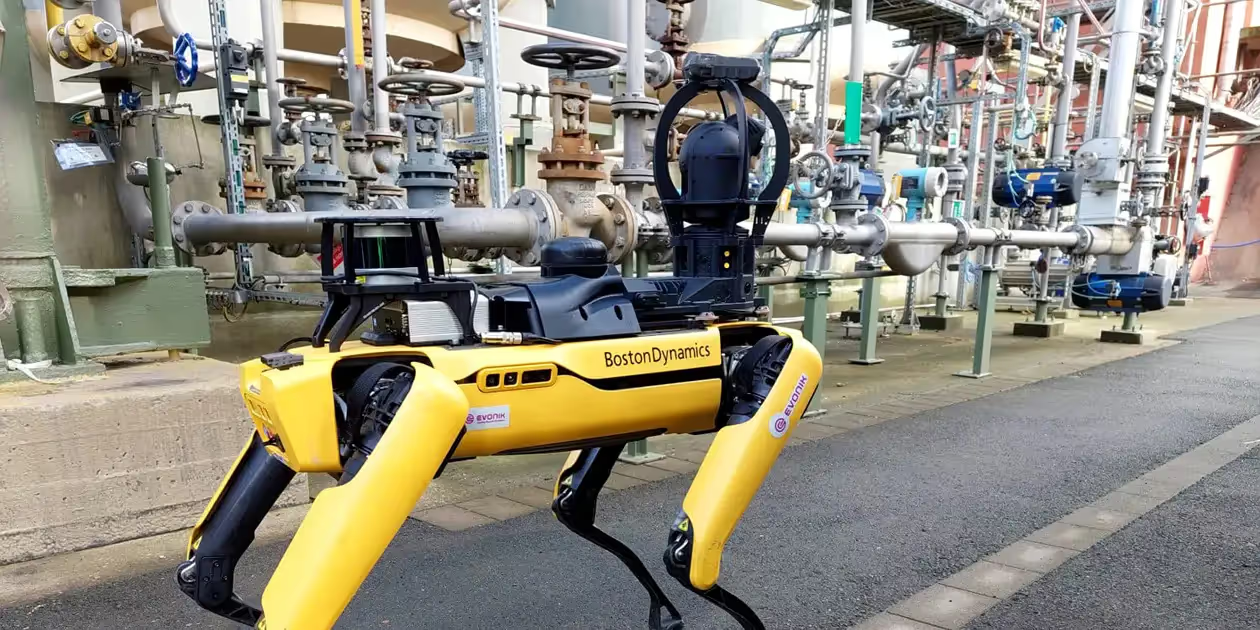
Evonik deployed a Boston Dynamics Spot robot equipped with optical and thermal sensors and powered by Korial to automate inspection in its test facility.
Through Korial, engineers remotely teach Spot precise inspection routes, define points of interest on analog gauges and critical assets, and then promote those routes to automated missions that execute on schedule, without requiring continuous on‑site control.
Korial ingests the robot’s sensor streams, reading analog devices, interpreting thermal images, and transforming every observation into structured data that can be trended, compared, and verified over time.
When readings deviate from expected baselines, Korial flags potential anomalies - such as excessive temperatures, leaks, contamination, or flow irregularities- so Evonik’s experts can intervene early and maintain the high safety standards demanded in chemical operations.
From Pilot to Scalable Autonomous Capability
With Korial, Evonik now has a governed framework for introducing mobile autonomy into chemical inspection: missions can be configured, adapted, and scaled without writing custom code or building new point solutions.
Engineers leverage Korial to refine routes, add new measurement points, and expand coverage as the facility and its testing requirements evolve, all while maintaining a consistent digital record of inspection activities.
Looking ahead, Evonik plans to extend this model beyond the test facility, using Korial and autonomous mobile robots to support inspection in live production environments, further reducing manual exposure and strengthening infrastructure resilience.
Korial’s autonomous inspection solution has shown us that mobile robots can perform inspection tasks consistently and deliver reliable data - exactly what we need in a chemical environment.
Ready to transform your operations?
Join leading enterprise organisations leveraging Korial to achieve operational autonomy.