
Autonomous Inspection at Scale Across Europe's Largest Refinery
Executive
Summary
Shell Energy and Chemicals Park Rotterdam (Shell Pernis) - the largest refinery in the European Union, covering an area equivalent to 1,000 football fields - required a fundamentally different approach to asset monitoring. At this scale, traditional manual inspection of thousands of assets daily was no longer sustainable: too slow, too inconsistent, and too exposed to human risk.
By deploying the Korial enterprise AI platform across a growing fleet of autonomous robots, Shell Pernis has shifted from manual, reactive inspection rounds to continuous, AI-driven operational intelligence. Robots now run 24/7, completing around three missions per day across 3,000 inspection points, with Korial's AI processing sensor data automatically and surfacing only the insights that require operator attention.
The result is a facility that is safer, more efficient, and better positioned to meet Shell's commitment to generating more value with fewer emissions.
The Challenge
Manual Inspection at Industrial Scale Is Unsustainable
Inspecting thousands of assets daily across a refinery the size of 1,000 football fields is not a task that manual methods can perform reliably, safely, or at the frequency modern operations demand.
Shell Pernis produces a broad range of energy products and materials essential to daily life and industry - and maintaining that output requires continuous monitoring of gas levels, pressure readings, valve positions, gauge values, temperatures, and more across an extensive and aging infrastructure. Historically, this meant inspectors on foot, rotating across hazardous zones, capturing data by hand under conditions that were physically demanding and operationally inconsistent.
The consequences of this model compounded over time: data quality varied between operators and shifts, anomaly detection depended on human observation rather than machine precision, and the volume of inspection points made comprehensive daily coverage increasingly difficult to guarantee. With safety a non-negotiable priority, sending personnel into hazardous environments for routine tasks that could be automated represented an avoidable and growing risk.

The Solution
A Platform for 24/7 Autonomous Operations at Enterprise Scale
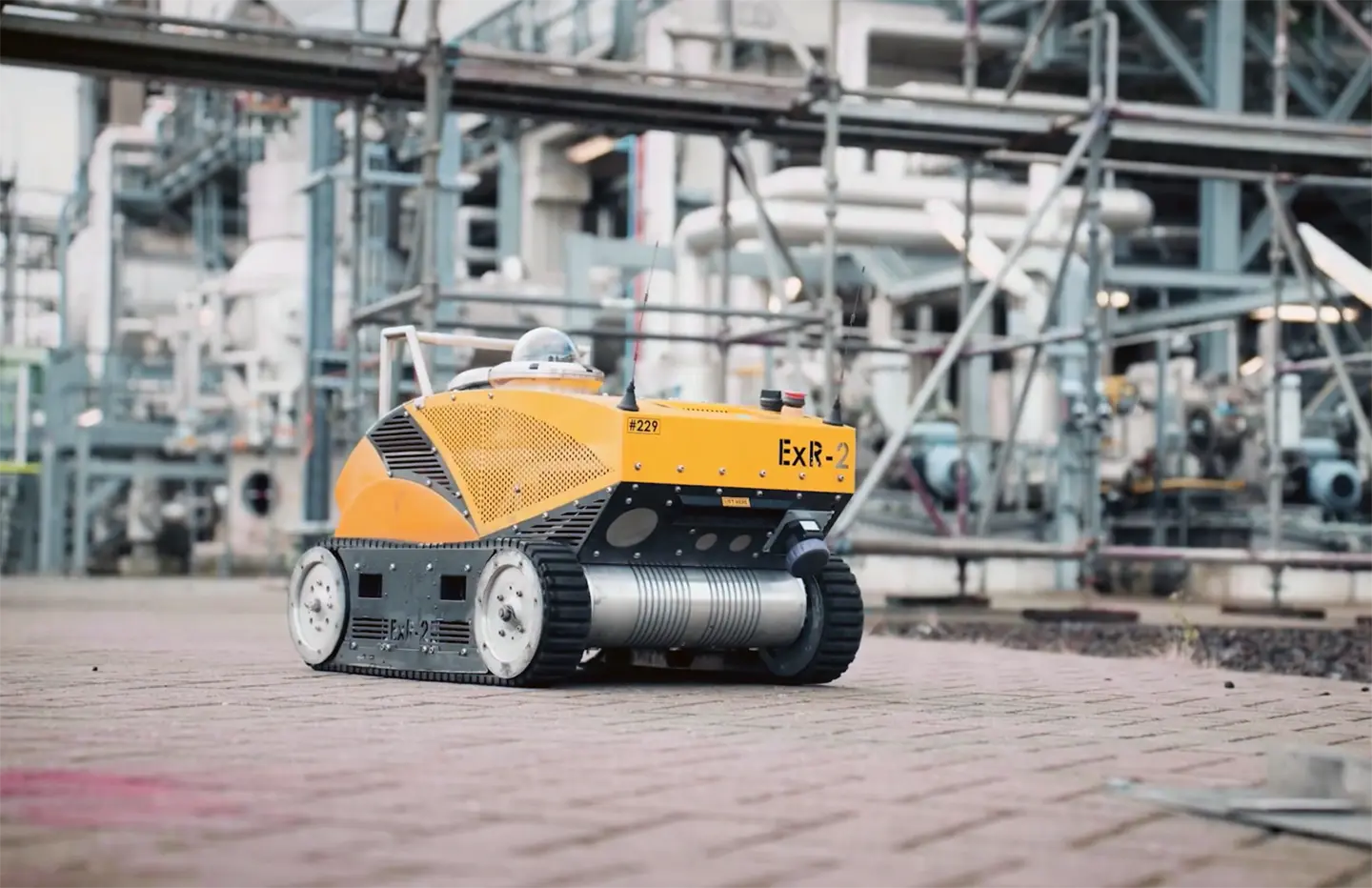
Shell selected Korial as the intelligence layer to orchestrate autonomous robotic inspection across Shell Pernis, beginning in 2020 with ExRobotics hardware and scaling continuously since.
Korial's hardware-agnostic platform enables Shell to deploy and manage multiple robots and drones from a single browser-based interface, regardless of the underlying hardware vendor. As Richard Weeda, Operational Focal Point Digitization at Shell, describes it: "Thanks to the Korial platform, we can choose whichever hardware - drone or robot - suits a particular task. This gives us way more freedom to move around our site and make the right inspections."
From a centralised control room dashboard, operators can monitor real-time robot status, review collected data, initiate ad-hoc missions, and redirect assets to emerging priorities - all without setting foot in the field. Weeda captures the shift in how operators now experience the site: "When we use the Korial interface, we can directly from inside our control room see our factory. It is a mobile camera that we can place anywhere in our factory where we want."
What began as daytime-only robotic rounds quickly demonstrated sufficient reliability and value to justify 24/7 operations. Today, robots complete approximately three missions per day, covering 3,000 inspection points and feeding a continuous stream of sensor data - gauge readings, thermal images, gas levels, valve positions - into Korial's AI processing layer. Daniel Boehmer, Digital Lead at Shell, describes the trajectory: "In 2020, we started our robotics journey by onboarding robots with the Korial platform. We started the project where we automate human-repetitive tasks. Today we operate our robots 24/7. They do around three missions per day, and they inspect 3,000 inspection points. We then apply AI to only bring the insights to operations."
Korial's machine vision algorithms process this data automatically, reading gauges from images, identifying anomalies in pressure and temperature, and delivering only verified, actionable insights to operators - replacing exhaustive manual data review with exception-based working. Daan Bruggink, Instrumentation Engineer at Shell, describes the result: "After our machine vision algorithms process one of the data inputs, operators can see the results automatically - like reading a gauge from the image. It's very important for us to have all the data in one place and one location, so that all operators from Shell can access it easily."
All data is unified into a single site model, integrated with Shell's asset management systems via API to enable timely alerts and seamless operational response. The platform's ad-hoc mission capability has proven particularly valuable in unplanned situations: when a section of the refinery tripped, operators deployed a robot to take temperature measurements in the affected hazardous area rather than sending a person in - exactly the kind of real-time operational resilience Korial is designed to enable.
Looking ahead, Korial is developing an evergreen digital twin for Shell Pernis - a continuously updated 3D model of the entire facility built from live inspection data - enabling operators to plan and assess site conditions remotely without requiring physical presence on site.
.avif)
We produce the energy of today and develop the energy of tomorrow. Our goal here is to generate more value with fewer emissions, and robotic inspections are helping us achieve that goal.
Ready to transform your operations?
Join leading enterprise organisations leveraging Korial to achieve operational autonomy.