360° Automated Inspection from the Ground and the Air
Executive
Summary
Shell Rheinland required a unified intelligence backbone to coordinate a mixed fleet of tracked robots, a legged robot, and a drone across one of Shell’s largest and most complex sites in Germany.
By deploying the Korial enterprise physical AI platform, Shell decoupled inspection and diagnostics from human logistics, replacing arduous manual tank and plant rounds with automated missions executed from the control room.
This architectural shift - from isolated OEM tools to a governed enterprise platform – has eliminated data silos, accelerated decision‑making, and enabled operators to manage a heterogeneous fleet from a single software environment.
The Challenge
Fragmented Operations in Hazardous Zones
At Shell’s largest facility in Germany, inspection teams depended on manual rounds through hazardous and Ex zones, introducing human latency into environments where every delay carries material safety and financial risk.
Critical anomalies in pressure, temperature, and leak behavior could only be identified once readings visibly drift, creating potential for unplanned downtime and multi‑million‑euro consequences.
As Shell began piloting individual robots and a drone to address this gap, each OEM understandably brought its own interface and data model - resulting in a diverse fleet that was harder to manage as deployments grew. Instead of a single source of truth, Shell faced scattered sensor streams and a continued reliance on manual data interpretation, which made it difficult to govern autonomy consistently at enterprise scale.

The Solution
One Intelligence Layer for a Mixed Fleet
Shell selected Korial as the strategic intelligence layer to standardize fleet governance, mission orchestration, and data handling across all ground and aerial agents on site.
Using Korial’s integration and command capabilities, Shell now manages a tracked robot, a legged robot, and an inspection drone through a single interface and data pipeline, independent of the underlying hardware vendor.
Visual, thermal, and gas sensors on each device feed into Korial’s AI‑native core, where physical AI reads analog gauges, interprets valve positions, analyses thermal images, and detects gas leaks down to ppm levels with consistent, machine‑grade precision.
When measurements deviate from defined baselines, Korial flags anomalies, routes verified insights into Shell’s operational IT stack, and equips operators with the exact context required to decide and act at speed.
360° monitoring from ground to air
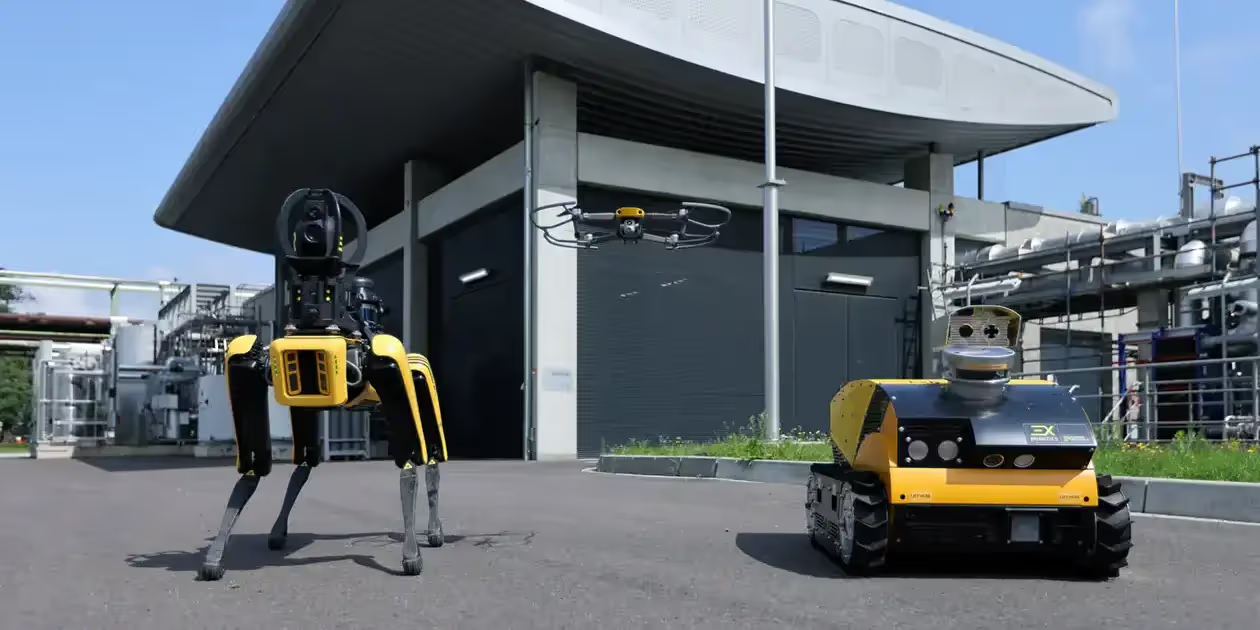
At Shell Rheinland, the ExR‑2 tracked robot performs inspection tasks in Ex zones, Boston Dynamics’ Spot navigates stairs and narrow areas in non‑hazardous environments, and a drone monitors tank roofs and hard‑to‑reach structures from the air.
Korial unifies these modalities into a coherent 360° inspection layer, ensuring every mission - whether on the ground or in the air -contributes to the same operational data pipeline.
By decoupling intelligence from the underlying hardware, Shell has secured hardware flexibility, improved efficiency, and a repeatable blueprint for scaling autonomous inspection across its wider portfolio.
.avif)
We are proud to have put a mixed fleet of autonomous inspection robots and a drone into operation. The different models give us the flexibility we need to inspect a large number of inspection points automatically.
Ready to transform your operations?
Join leading enterprise organisations leveraging Korial to achieve operational autonomy.