
Autonomous Inspection
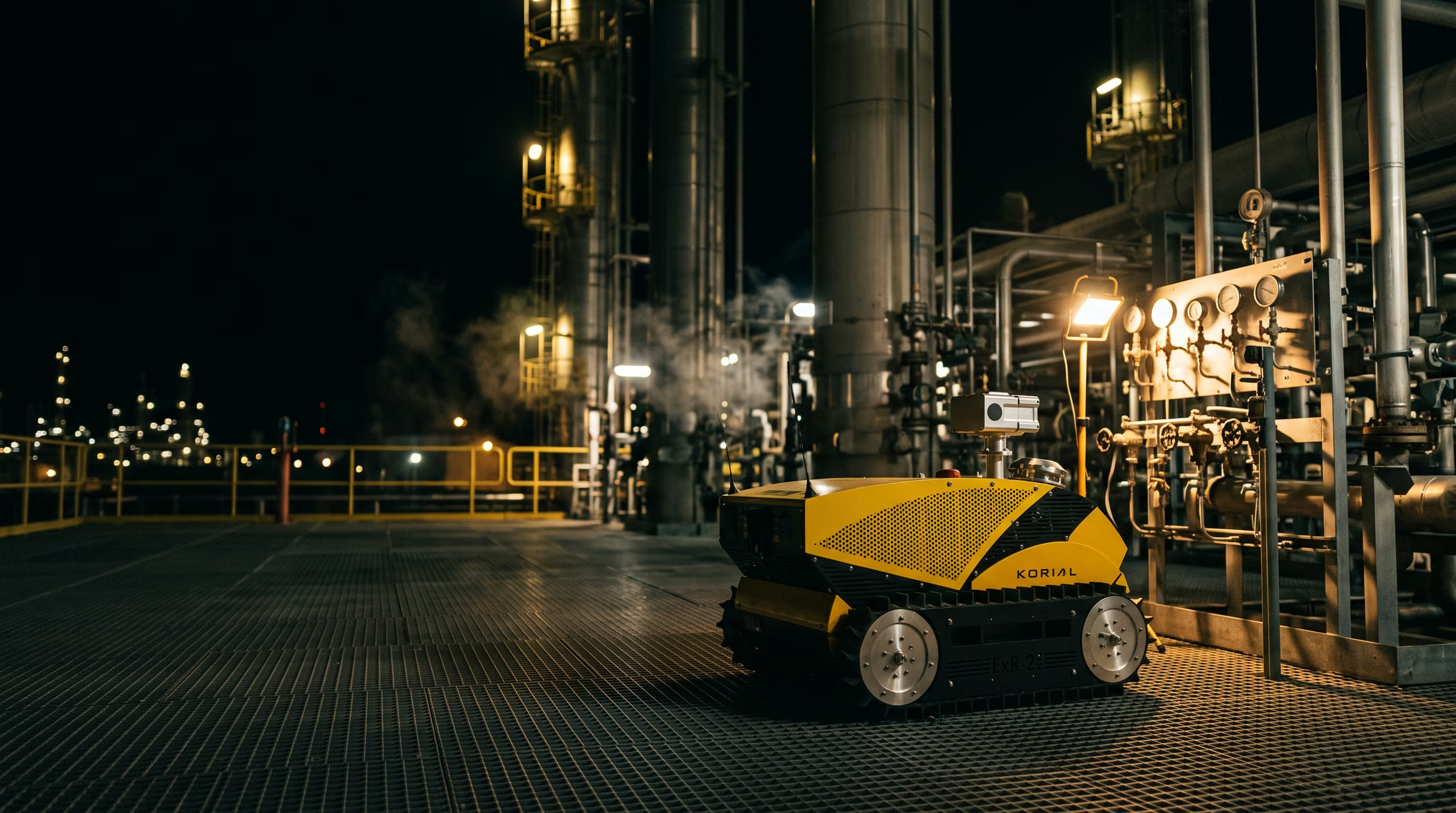
Keeping industrial infrastructure safe and productive means inspecting it constantly, and for generations that has meant sending people into hazardous zones to do it. Korial changes that. The platform directs fleets of robots and drones to run inspection missions systematically, reading gauges, confirming asset states, and capturing verified data at every Point of Interest, while your people stay out of harm's way.
From mission design to fully autonomous execution, Korial turns routine inspection into a systematic, repeatable operation, run by robots and drones and directed by your people.
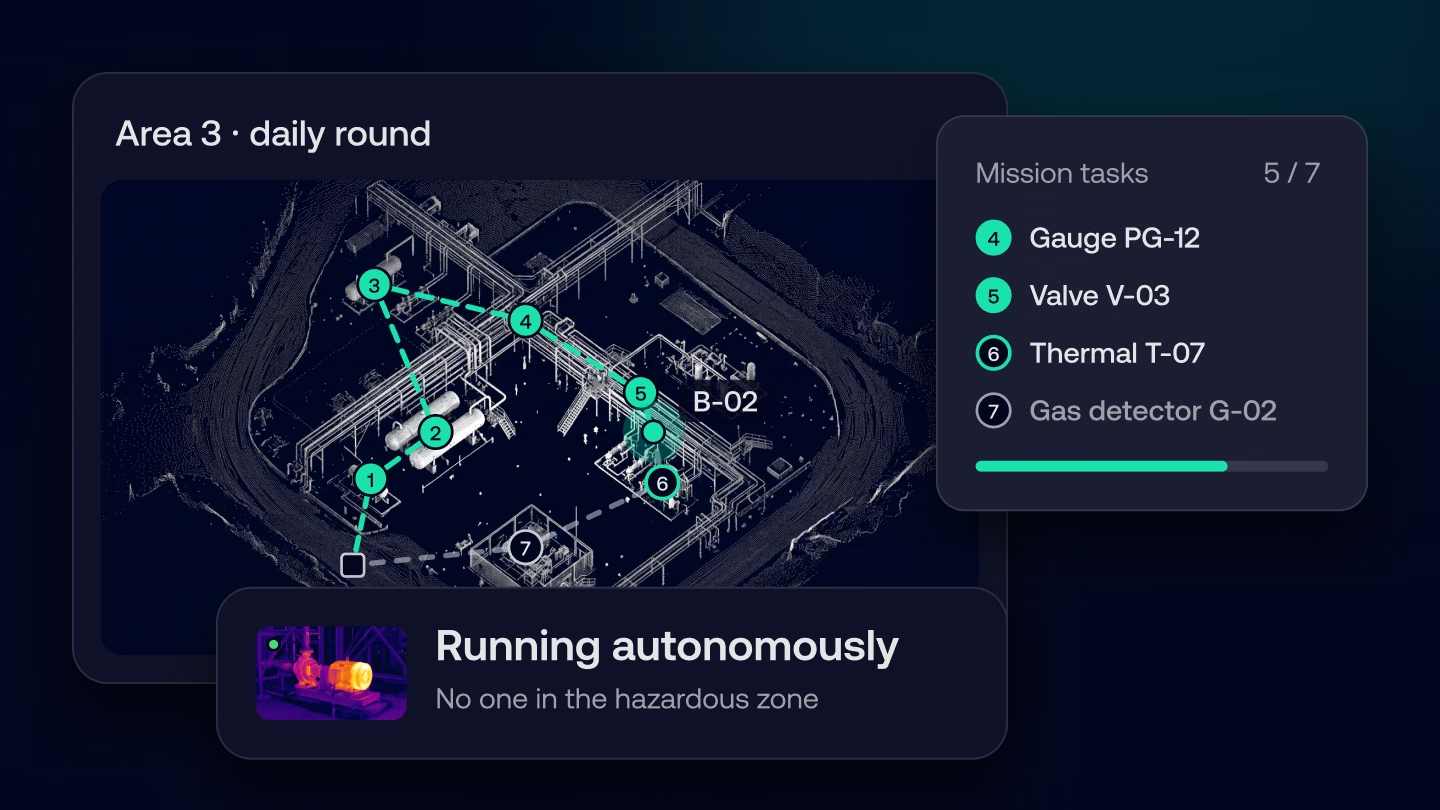
Autonomous Mission Execution
Korial directs robots and drones to run inspection missions across your facility on demand, capturing the data your operation depends on while no one stands in the hazardous zone. The routine, repetitive rounds that once took up skilled people's time now run autonomously.
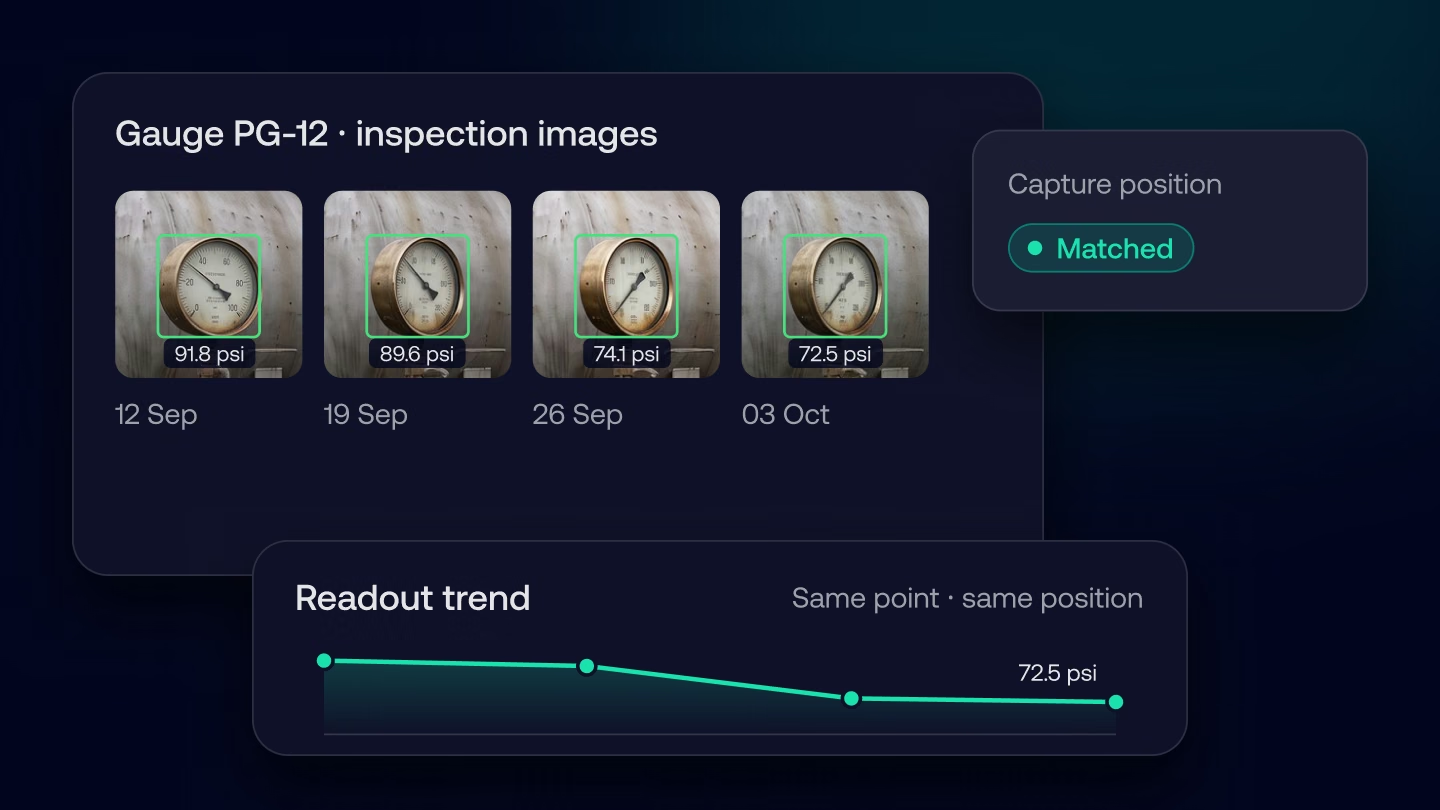
Consistent, Repeatable Data
Every mission runs to the same standard, capturing the same Points of Interest from the same position. Human variability drops out of the record, and each capture adds to a comparable history of asset health over time.

A Safe Path to Full Autonomy
Run inspection missions under human supervision first, then move each mission to fully autonomous execution once its performance is validated. Operators can take manual control of any robot or drone at any point, with obstacle detection as a fail-safe.

Missions Built from Points of Interest
Operators build inspection missions by selecting Points of Interest on a 3D model of the site, then test them in simulation before they run live. Designing a mission becomes a matter of choosing what to inspect, not programming how.
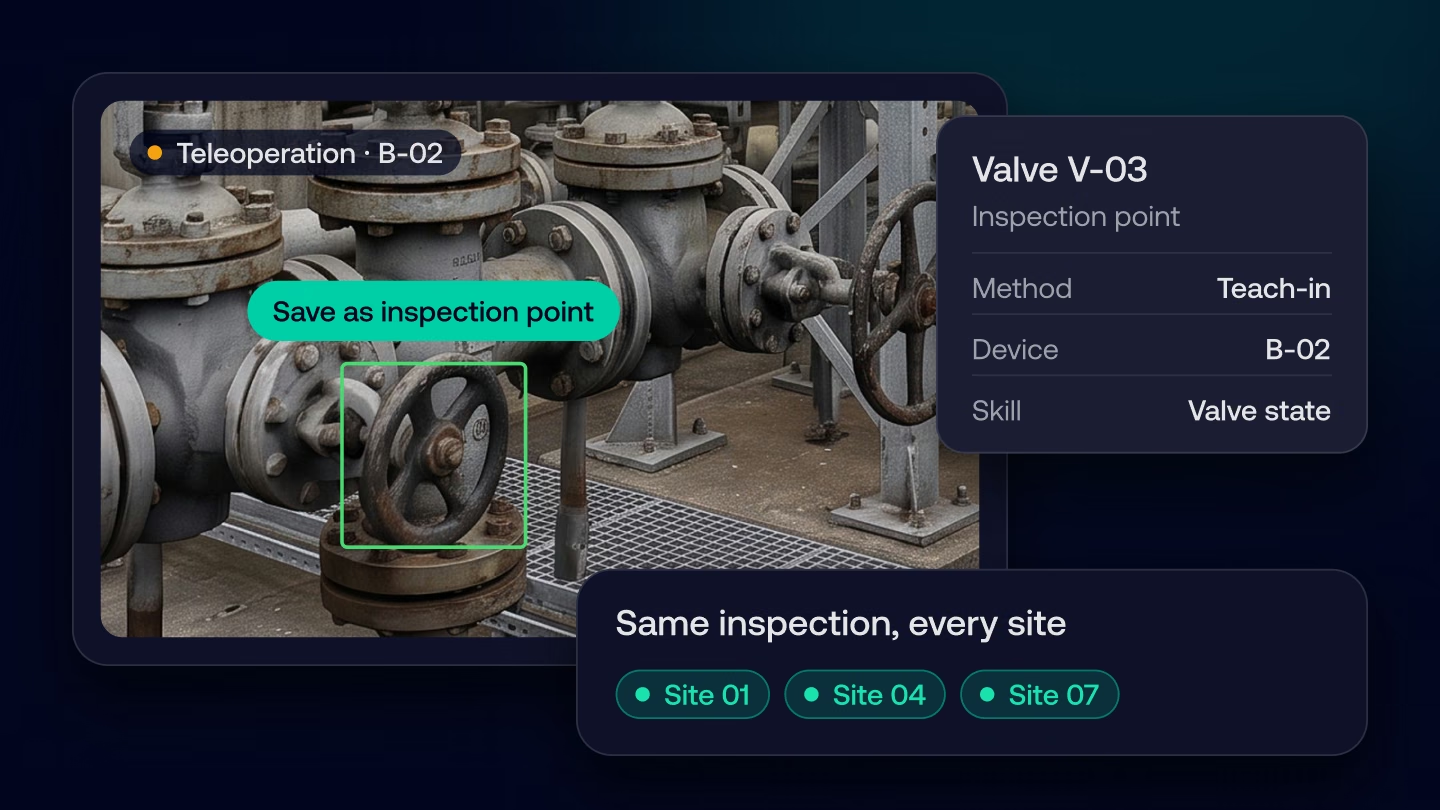
Capture and Scale Expert Technique
Capture how your people inspect an asset. Show a robot or drone the point once during teleoperation, and it repeats that exact inspection autonomously on every future mission. Reusable AI skills apply the same inspection logic from site to site, so capability scales consistently.
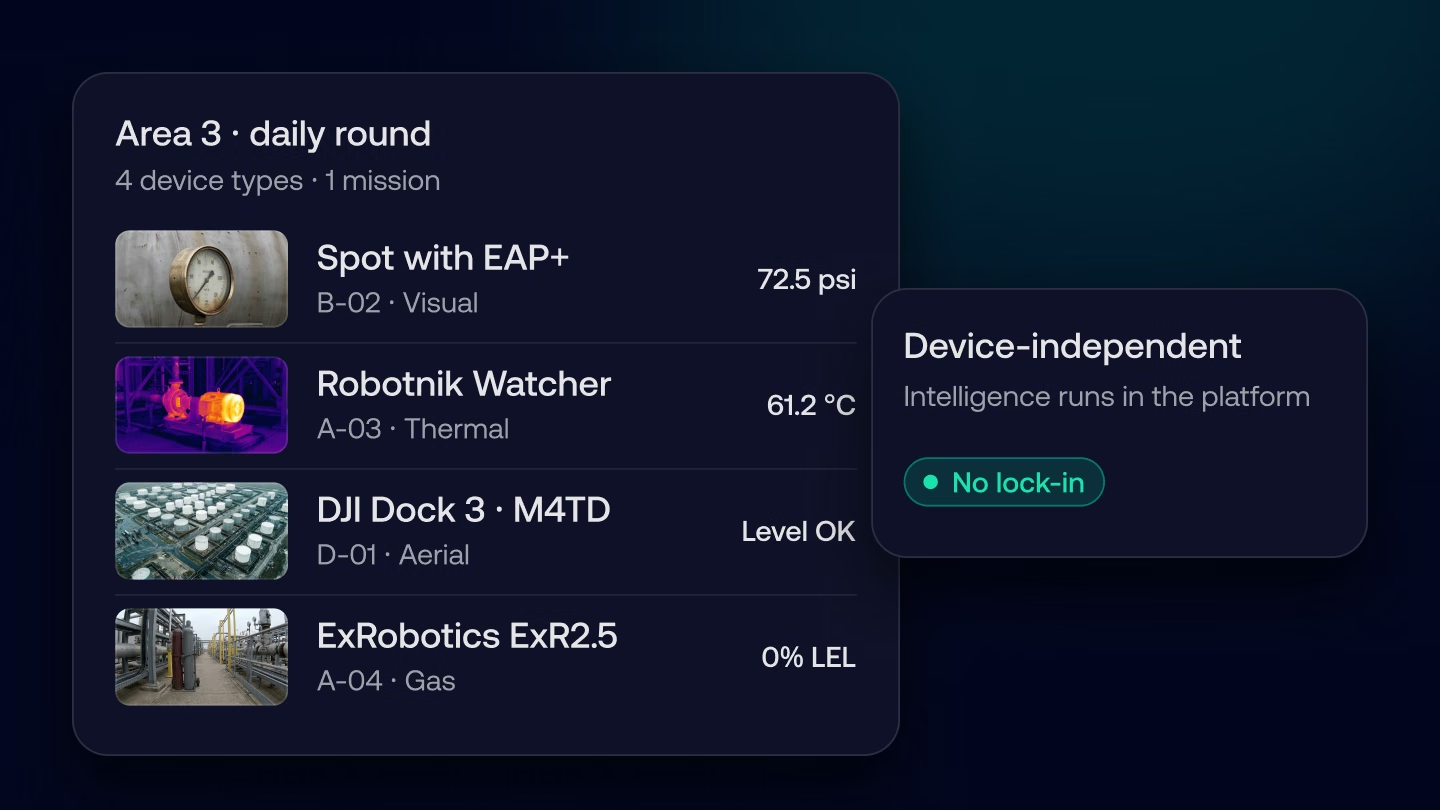
Any Robot or Drone, Any Sensor
Korial coordinates mixed fleets of robots and drones across visual, thermal, audio, and gas sensing as one operation. Because the intelligence sits in the platform rather than the hardware, autonomy extends across any supported manufacturer without lock-in.
Gauge Detection & Reading
Finds analog gauges, reads the needle, and stores each value as a data point on every mission, so any instrument becomes a trend over time.
Label & Text Reading (OCR)
Reads text from asset tags, signage, and nameplates within defined areas of each capture.
QR Code Reading
Reads QR codes to tag assets and identify equipment during a mission.
Handle Valve State
Reads whether straight-handle valves are open, closed, or in a custom position, against the expected state.
Wheel Valve Detection
Detects and counts wheel valves at each inspection point.
RCU Switch Position
Finds RCU switches and reads whether each is off, neutral, or on.
Seal Presence Detection
Confirms tamper seals are in place on valves and equipment.
Lube Oil Level
Finds lube oil cups and reads the fill level as a percentage.
Thermographic Analysis
Measures minimum, maximum, mean, and center temperature for each capture or defined region, surfacing hotspots and thermal variances.
Gas Detection & Mapping
Logs gas readings along every route, builds a gas map after each mission, and raises live alerts when a limit is exceeded.
Spill & Puddle Detection
Detects liquid pooling at ground level along the route.
Audio Capture
Records sound at Points of Interest and shows how it changes over time for review.
Human Detection
Detects people in visual or thermal images captured during a mission.
Fence Defect Detection
Checks perimeter chain-link fencing for holes and damage.
Fire Extinguisher Detection
Confirms extinguishers are in place where they should be, on every mission.
Safety Equipment Checks
Checks for common safety items and hazards, including spill kits, signage, first-aid stations, blocked exits, and debris in walkways.
Tank Roof Water Level
Uses aerial inspection to check whether water on a floating tank roof has reached a critical level.
3D Site Mapping
Captures LiDAR maps of the site as robots and drones move through it.
The Wrong Job for a Human
For decades, keeping a facility safe has meant sending people into it: walking hazardous zones with a clipboard and a camera, reading the same gauges along the same route, day after day. It is slow, costly, and inconsistent, and it puts skilled people in exactly the environments an enterprise works hardest to keep them out of.
The work itself rarely needs a human. What it needs is to be done systematically, accurately, and often. Yet every manual round carries the cost of mobilizing people, the risk of exposure, and the variability of human attention across a long, repetitive shift.
Korial takes the person out of the hazard, not the rigor out of the work. Robots and drones run the routine missions to the same standard every time, while your experts move from walking the plant to overseeing it, focused on the decisions only people can make.
From Mission Plan to Autonomous Execution
It starts with a model of your site. Recreate builds a simulation-ready environment from a scan of your facility, whether you already hold one or need one captured. Operators define Points of Interest and build missions from them, choosing what to inspect rather than coding how, then test each mission in simulation before it runs live.
From there, the fleet takes over. Whatever the robot or drone, and whatever the manufacturer, each runs its mission to specification, navigating the site, capturing the data, and detecting obstacles as a fail-safe: under supervision at first, then fully autonomously once performance is validated.
Every mission feeds the same platform. Captures reach Korial as they are taken, AI skills analyze everything the fleet records, from gauge readings and valve states to thermal, gas, and site safety checks, and the results surface as insights and alerts in Kore. What begins as a single autonomous mission becomes a continuous, repeatable inspection capability.
“Send the fleet where people shouldn't go. Keep your experts where they matter.”
When robots and drones take on the routine rounds, the results show up where they matter: in people kept out of hazardous zones and far more of the plant inspected, far more often.
1M+
40
7k
Ready to transform your operations?
Join leading enterprise organisations leveraging Korial to achieve operational autonomy.