Autonomous Inspection for Oil & Gas.

Built for the industry's most hazardous environments, from rigs and refineries to remote terminals, and proven in ATEX Zone 1. Robots and drones run inspection missions through your hazardous areas, reading gauges, checking for gas, and spotting thermal anomalies, while your people stay out of the zone.
In a refinery or terminal, risk builds up between inspections. Manual rounds reach hazardous areas only so often, so a developing fault, such as a small leak, an overheating pump, or a gauge drifting out of range, can go unnoticed until it causes downtime or damage. Industry benchmarks put unplanned downtime at around USD 285K an hour, and in these environments the cost of a missed warning can be measured in more than money.
Most operations also run a mix of robots, drones, and systems from different manufacturers, each with its own interface, data format, and cloud. There's no single view, no consistent standard, and no easy way to scale what works at one site to the next.
Korial solves both problems. One platform directs robots and drones from any supported manufacturer, inspects hazardous areas far more often than manual rounds allow, and brings every finding into one trusted record, ready to flow into the maintenance systems your teams already use.

Korial is already running autonomous inspection in live oil and gas operations. At one European refinery in ATEX Zone 1, a fleet of six has operated since 2021, inspecting 7,000 Points of Interest a week with 97% detection accuracy.
In the field, AI skills read every gauge, check every valve, and analyze every thermal and gas reading as it's captured. When a reading crosses a limit, operators get a severity-ranked alert with the image and data behind it, so the most serious issues get addressed first.
Because the intelligence sits in the platform rather than the hardware, you can add robots and drones from different manufacturers without adding another system to manage. Missions are built and proven in simulation before deployment, so less time is spent correcting them in hazardous areas.
The result is inspection that runs to the same standard on every round, with people moved away from the most dangerous work and toward the decisions that need their expertise.

“The most dangerous inspection rounds no longer need a person to walk them.”


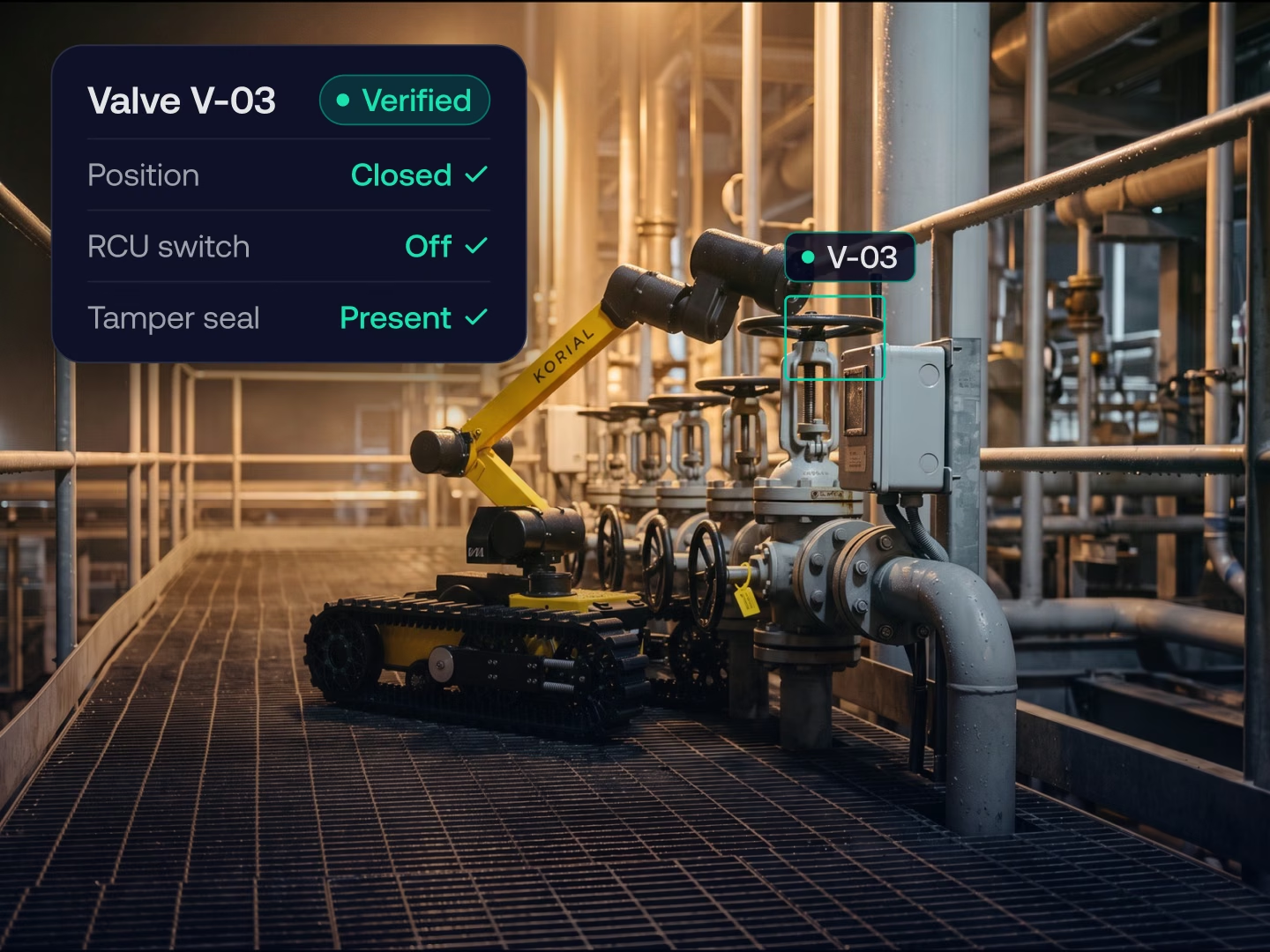
Across the world's most demanding energy operations, autonomy delivers a measurable return: fewer people in harm's way, faster detection of critical faults, and higher utilization of every asset you run.
$3.3M
40
97%
Korial is proven in the field with deployments across some of the largest and most complex oil & gas facilities worldwide.

At Shell Energy and Chemicals Park Rheinland, Korial coordinates a mixed fleet of ground robots and an aerial system to deliver continuous, risk‑aware inspection and routine rounds for asset condition monitoring.
Ready to transform your operations?
Join leading enterprise organisations leveraging Korial to achieve operational autonomy.