
Infrastructure Monitoring

In high-risk industrial environments, conditions never stop changing: a seal degrades, a temperature climbs, a trace of gas appears where it shouldn't. Korial keeps watch over the health of your assets and the conditions around them, mission after mission, checking every inspection reading against its expected range and its own history, and raising the alarm the moment something drifts.
Korial turns inspection data from every mission into a living picture of asset health, so risk is caught early, prioritized, and resolved before it becomes a failure.

A Living Record of Asset Health
Korial tracks every Point of Interest over time, with the image and data behind each capture, so every new reading is understood against the asset's own history and expected range. Slow drift that comes before failure stands out early, giving maintenance teams the evidence to plan work before it becomes urgent.

Automated Anomaly Detection
Korial's AI skills analyze each capture as it arrives, flagging thermal variances, gas readings over limit, and liquid pooling where it shouldn't be. Every finding is ranked critical, warning, or information, so the most serious issues get addressed first, without waiting for manual review or the next report.

Environmental Awareness
Beyond asset condition, Korial watches the environment itself, logging gas readings along every route, detecting spills at ground level, and recording audio at Points of Interest, with live sensor readings in view as each mission runs. Where a trace of gas can escalate quickly, early detection matters most.
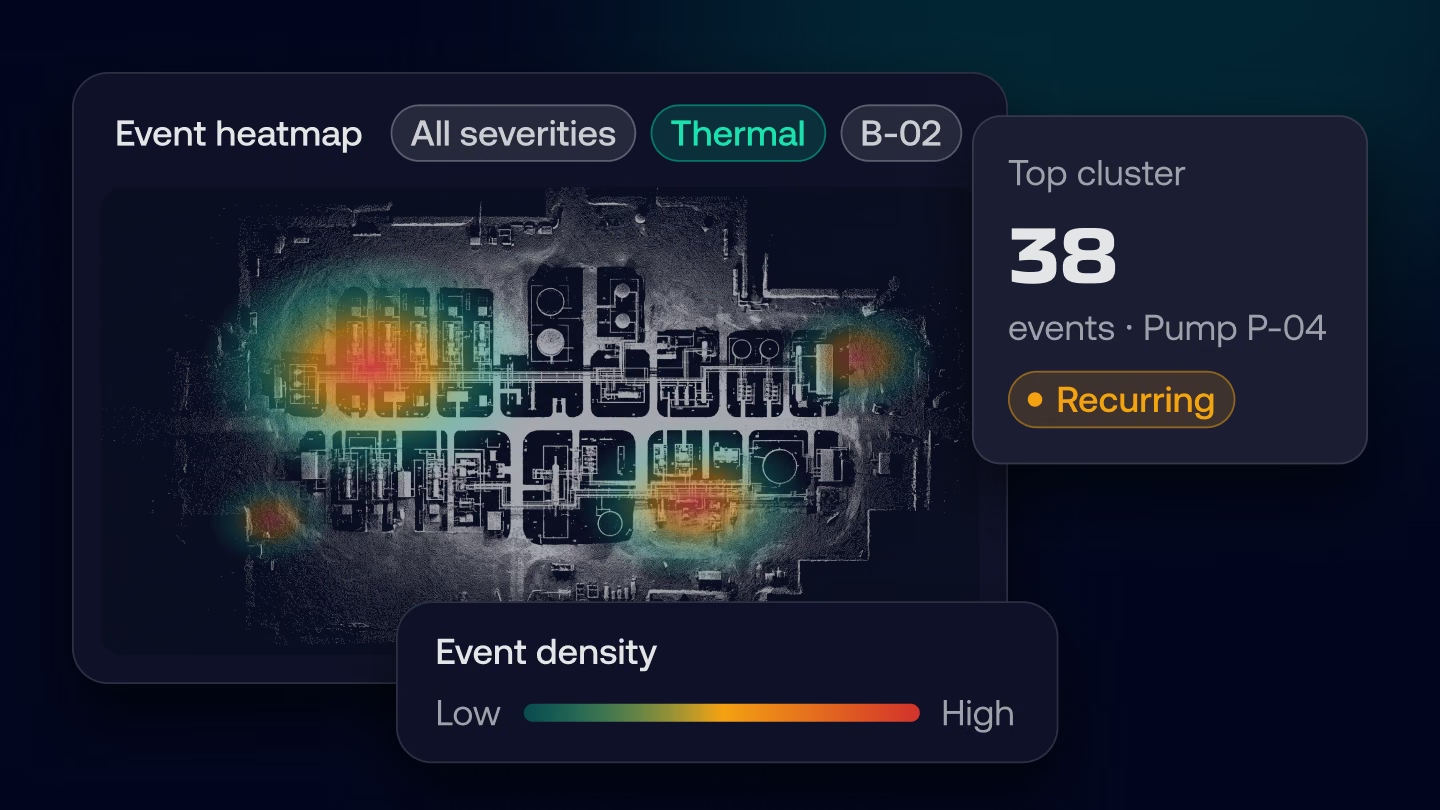
Where Issues Cluster
An interactive heatmap shows where events concentrate across a site, filtered by severity, event type, or robot, so recurring problem areas become visible and can be addressed at the source rather than one alert at a time.

From Early Warning to Planned Work
Verified findings and alerts can flow into your EAM and maintenance systems through secure APIs, so the evidence behind every early warning reaches the teams who schedule the work, without being re-entered by hand.

Answers in Plain Language
Operators ask Kori about any asset in plain language, from the latest reading or inspection image to how its condition has trended over time, with no specialist analytics skills required.
Gauge Detection & Reading
Reads analog gauges on every mission and stores each value as a data point, so pressure, temperature, and flow readings become trends that reveal drift early.
Thermographic Analysis
Measures minimum, maximum, mean, and center temperature for each capture or defined region, surfacing hotspots and thermal variances.
Lube Oil Level
Reads the fill level of lube oil cups as a percentage, an early indicator of wear on rotating equipment.
Seal Presence Detection
Confirms tamper seals are in place on valves and equipment, mission after mission.
Handle Valve State
Checks straight-handle valves are in their expected position, flagging any that aren't.
Gas Detection & Mapping
Logs gas readings along every route, builds a gas map after each mission, and raises live alerts when a limit is exceeded.
Spill & Puddle Detection
Detects liquid pooling at ground level along the route.
Audio Capture
Records sound at Points of Interest and shows how it changes over time for review.
Tank Roof Water Level
Uses aerial inspection to check whether water on a floating tank roof has reached a critical level.
Every Outage Was Once a Warning
Serious failures rarely happen without warning. A bearing runs hot for weeks. A pressure gauge drifts out of range. A gas reading creeps upward before it trips an alarm. The signs are almost always there; the problem is that periodic inspection only looks occasionally, leaving long gaps in which a small, detectable issue becomes an expensive, dangerous one.
For the enterprise, those gaps are where the real cost lives: unplanned downtime, emergency repairs, safety incidents, and lost production. Industry benchmarks put unplanned downtime at around USD 285K an hour. Reacting to failure is always more expensive than preventing it, and in hazardous environments the stakes are measured in more than money.
Korial closes the gaps. By inspecting far more often than manual rounds allow, the platform catches the early warnings periodic checks miss, gives maintenance teams time to plan rather than react, and protects both uptime and the people who depend on it.
From Early Signal to Planned Action
Mission by mission, robots, drones, and third-party sources feed Korial data on the condition of every asset and the environment around it. The platform doesn't wait for a scheduled review; every capture is analyzed as it arrives.
Korial checks each new reading against its expected range and the asset's history, separating ordinary variation from genuine change. When something drifts, the platform flags it straight away and ranks it by severity, with the inspection image and data needed to act.
Over time, the same record shows how each asset is trending, so the slow patterns that come before failure become visible early. Monitoring turns into planning: the evidence for the next maintenance decision is already in the platform, and can flow straight into the systems your maintenance teams use.
“The warning is always there. Now it gets seen in time.”
When every reading is checked against its history and expected range, the results show up where they matter: in issues caught earlier and maintenance planned before it becomes urgent.
97%
10x
24/7
Ready to transform your operations?
Join leading enterprise organisations leveraging Korial to achieve operational autonomy.