Click and Inspect: Redefining Autonomous Inspection

Robots have been plugging gaps in ageing workforces across the world and helping countries navigate a demographic crisis.
This is especially true in capital-intensive industries, where robots are increasingly being deployed to perform routine inspection tasks and monitor critical assets in massive refineries, offshore sites and chemical plants. Given the expansive scope of inspections in such diverse facilities, industries require drones and fleets of specialist robots equipped with different sensors that are tailored to these conditions.
How can such a heterogenous fleet of robots be managed in a simple and effective manner? In essence, how can we move from a robot-centric model to a site-centric model of inspection? We provide the answers to these questions with our exciting, brand-new feature, Click and Inspect.
How to Train your Robot Fleet?
So far, the training of robots for autonomous inspection rounds has essentially been a “Teach and Repeat” process. Using Energy Robotics’ proven User Interface (UI), the robot is manually driven through the intended inspection route consisting of the desired point of interests (POIs). Once the robot reaches a POI (e.g., dial gauge), an appropriate sensor (e.g., zoom camera) and its respective action (e.g., photo) is chosen in the UI. The robot is driven to all POIs on the route and actions (such as capturing visual, thermal, or audio data) are added for each one of them.
Upon completing the teach-in round, the robot can be tasked to repeat it autonomously without any human interference. Most inspection rounds can be taught to the robot in a matter of minutes, and from then on, the robot can be called upon at any time to execute them autonomously, just as they were taught.
Although “Teach and Repeat” is a quick and intuitive method of onboarding a robot fleet to an industrial team, the robots are confined to the inspection rounds taught to them. They cannot be tasked to perform new or extended rounds on the fly and their operation can be hindered by unexpected obstacles in the environment caused due to scaffolding works, for example. These challenges can be overcome by moving from a robot-centric to a site-centric model of inspection. This is where Click & Inspect comes in…
Moving to a Site Centric Model: Click & Inspect
With Click and Inspect, “Teach and Repeat” (described above) forms the base for a site-scanning mission with a three-fold objective:
1. Defining robot path: By manually driving the robot along the inspection route, the allowed paths of the robot are defined for when it performs autonomous rounds later. This is very useful in making sure robots do not enter no-go zones (e.g., non-certified robots in ATEX zones).
2. Defining POIs: The desired POIs that need to be monitored are scanned and defined during the teach-in and the 3D representation of these POIs are later displayed on our brand new site-centric UI. Details about the POI such as type, nominal values, name is stored in the database for use on the Click & Inspect mission.
3. Constructing a site map/site setup: Equipped with a LiDAR scanner, the robot builds a 3D site map/digital twin of the facility during the teach-in. This process is automatically performed in the background without any effort by the operator.
What will customers gain from Click & Inspect?
Once the site-scanning mission is completed, operators can create new inspection rounds by selecting the desired POIs represented on the digital twin of the site, without having to manually drive the robot. Furthermore, through accurate scanning of the site, the robots can easily avoid obstacles and dynamically adapt to changes in site geometry.
By embracing a site-centric view, Click and Inspect makes autonomous inspection a plug-and-play solution: the robots are inspection-ready through a quick site-setup and operators can create and execute inspection rounds on the fly. Of course, Click & Inspect applies to each crawling, rolling, walking and flying robot in the customer's fleet.
Watch Click & Inspect in Action!
To see this game-changing feature in action and learn how it revolutionises autonomous inspection, book a demo.
More Exciting Features Coming Soon
The first version of the Click & Inspect (C&I) function will be rolled out in April 2022 and will be available to selected customers in various industries. The following features will be added to the MVP during the course of the year:
1. Centralized monitoring of all POIs
Multiple Teach-ins: In the future, it will be possible to collate POIs from multiple teach-in rounds and represent all of them together on the 3D site map. This means operators can teach-in rounds at various areas of the facility and all the POIs scanned from these rounds will be available for C&I. This will further increase flexibility when training and maintaining complex missions.
Multiple Robots: Later this year, it will be possible to extract POIs from multiple robots (and robot types) in the facility. Thus, POIs collected by all robots will be available for C&I and the information collected by one robot can be shared with the entire robot fleet. This will be an important step for moving from a robot-centric to a site-centric inspection management model.
2. Robot platforms:
In the first version, C&I will be available for ExR-2. It will be available for Drones later this year.
3. On-demand inspection from anywhere on the site:
As of now, inspection rounds can be planned such that they start from the undocking of the robot and end with the docking of the robot. In the future, inspection rounds can be planned and executed on-demand, independent of the position of the robot on the site. This means that a robot can be ordered to inspect a particular POI, regardless of its position (and without undocking or docking).
4. New site-centric user-interface:
The existing robot control UI, which has already been very well received by our customers, will be complemented with a brand-new site-centric UI. The functionalities of the site-centric UI include importing of site data directly and performing ad-hoc inspection rounds through Click and Inspect.
While C&I runs on the site-centric UI, the teach-in rounds will still be executed on the robot control UI version for now. The entire ER platform will be further upgraded this year to extract the full potential of the new site-centric UI.
5. C&I directly from customer’s digital twin
The robot teach-in process can be supported or replaced by directly using digital twins of inspection sites from customers.This means that the information required for C&I (POIs, sitemaps and allowed robot paths) is provided by the customer and there is no need for site-scanning missions.
For our customers with no (or outdated) digital twins, the teach-in functionality will continue to be available, enabling them to build an accurate digital twin quickly and run on-demand inspection rounds through C&I.
Related posts
More Perspectives from Korial
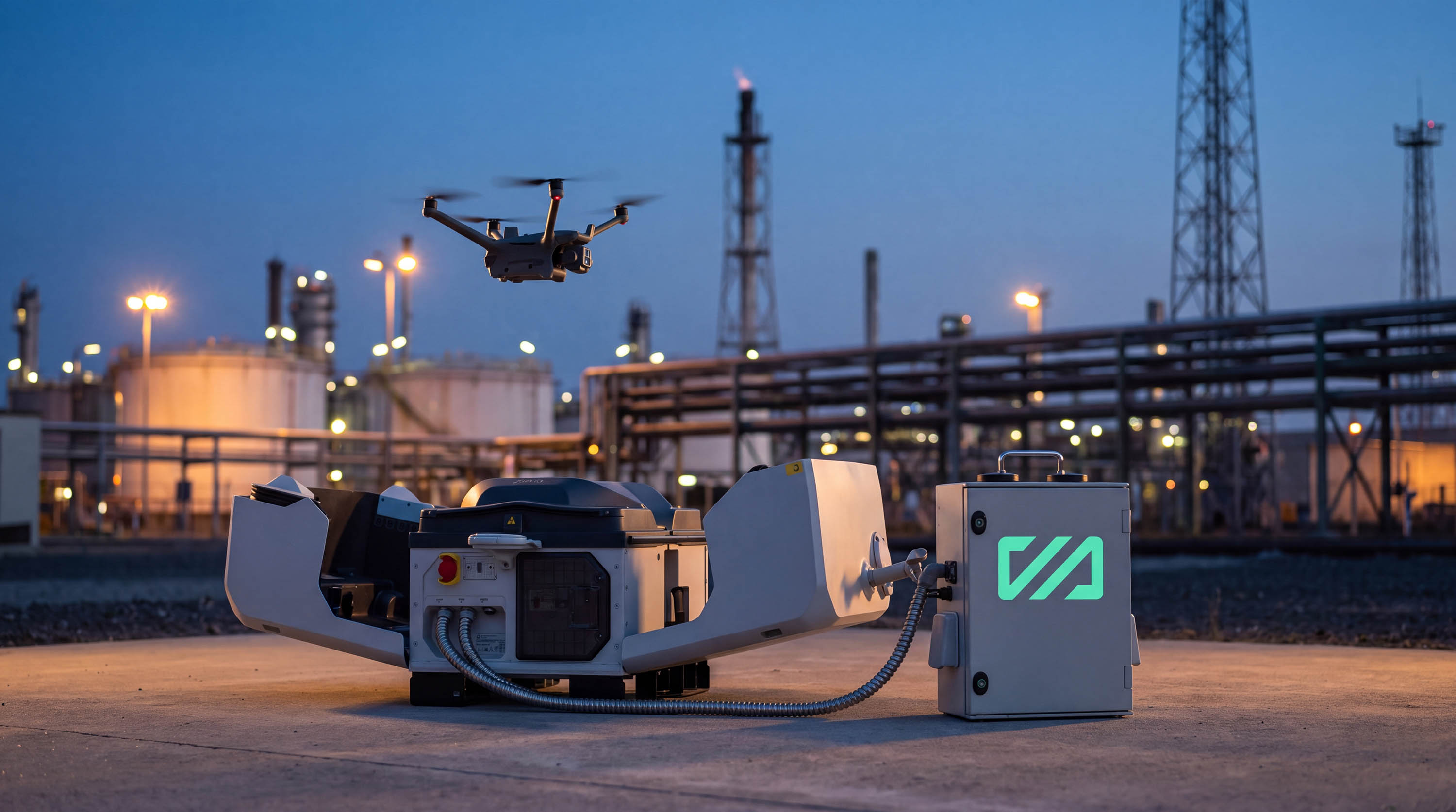
Your Drones Collect the Data. Who Controls It?
Every day your drones photograph your equipment, read your gauges, and scan for leaks. On many platforms, that data travels into the manufacturer's cloud, often outside Europe, before you ever see it. Since September 2025, European law says the data is yours. Here's how to take control of the path it travels, without replacing the fleet you already operate.

The Software Architecture Required to Scale Autonomous Operations
How a unified intelligence layer turns fragmented field-autonomy trials into a single, scalable enterprise estate.

The Crucial Role of Inspections in the Oil and Gas Industry
Reliable daily inspections are critical for safe and efficient operations in the oil and gas industry. This article covers the various inspection methods ensuring smooth operations

A Guide to Choosing the Ideal Inspection Robot for Your Facility
Looking for the perfect robot to streamline your operations? Our comprehensive guide helps you choose the ideal robot for your use case.

Industrial Gas Leak Detection: Definition, Types & Detection
Learn why detection of industrial gas leaks is critical to safety, the environment and efficient operations, and the best leak detection methods for different gases.

Turnaround Time (TAT) : A Comprehensive Guide
This guide about turnaround time (TAT) explains its impact across different industries and how to reduce it with different technologies such as autonomous robots and drones.
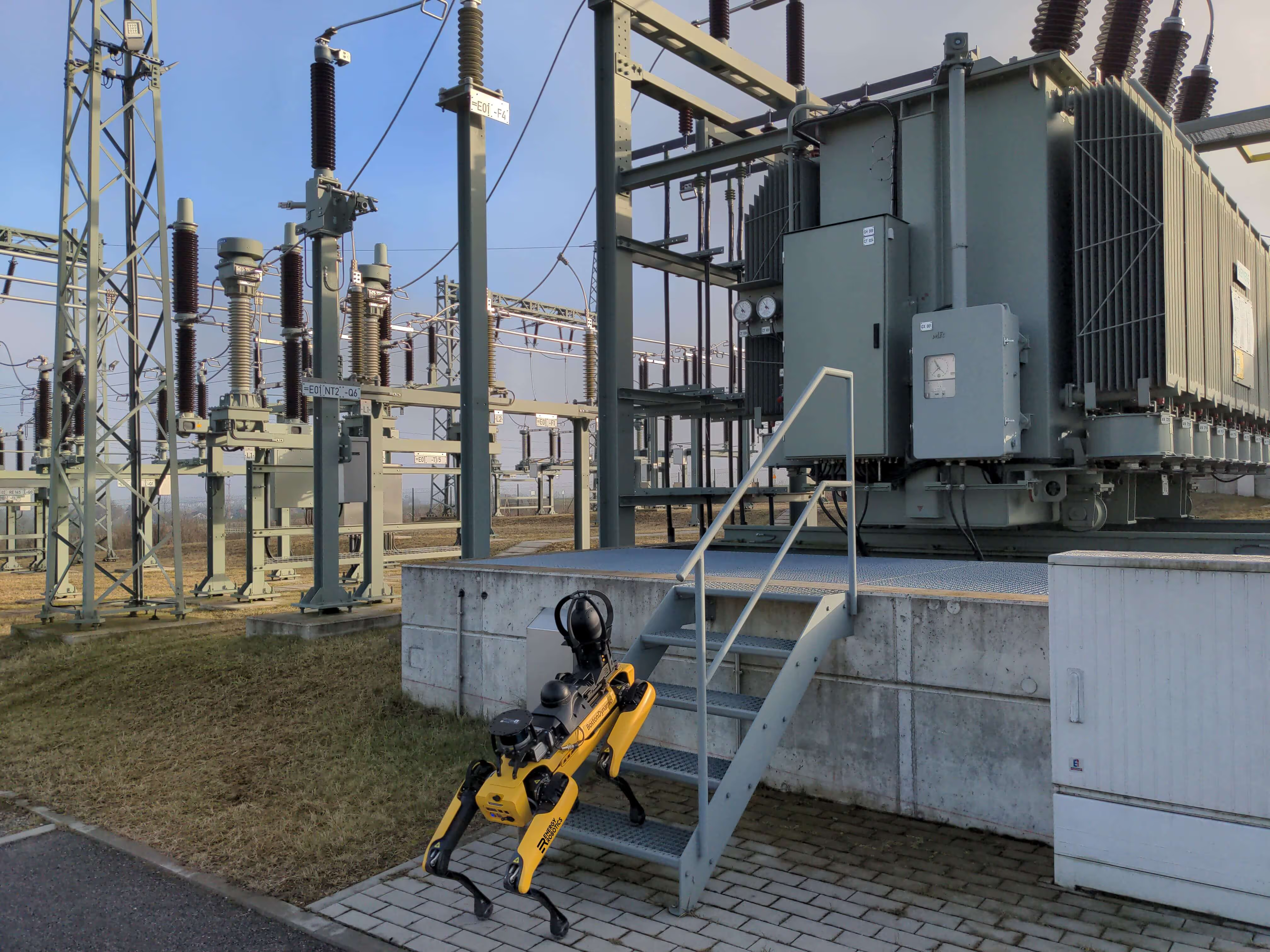
On-Demand Inspection Rounds: Revolutionizing Industrial Plant Inspections
Learn how operators are now only called into action under exceptional situations, while robots and drones perform multiple daily inspection rounds with no human intervention.

Automate Tank Roof Inspections with Advanced Industrial AI
Korial offers an automated drone inspection solution for tank roofs, reducing manual work and improving safety with AI-driven data analysis.
Ready to transform your operations?
Join leading enterprise organisations leveraging Korial to achieve operational autonomy.